
Why Joule Needs a Clean Core First: The 2027 Sequencing Problem
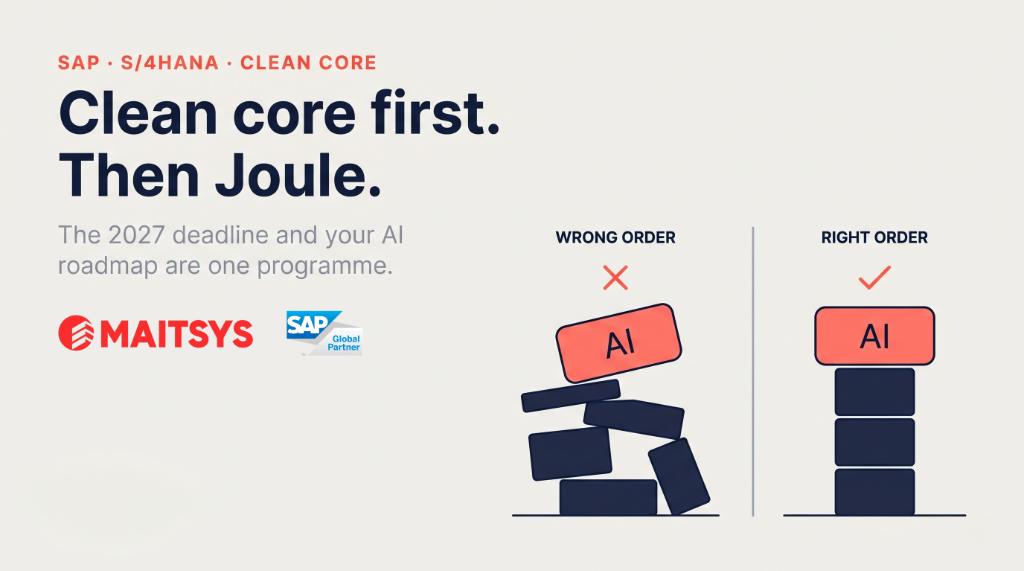
In brief: Most enterprises are running their S/4HANA migration and their SAP AI strategy as two programmes with two budgets and two steering committees. They are one programme. The extensions that break your upgrade are the same extensions that make your business logic invisible to Joule. Sequence clean core first and AI enablement becomes a configuration exercise. Sequence it second and you will pay for the same remediation twice.
The two dates that are actually one date
Two clocks are running in every SAP estate right now, and most boards are treating them as unrelated.
The first is well understood. Mainstream maintenance for SAP ERP 6.0 enhancement packages 6, 7 and 8 ends on 31 December 2027. Extended maintenance is available at additional cost through 31 December 2030, and SAP has committed to supporting at least one S/4HANA release until 2040. That is the compliance clock, and it has been on the risk register for years.
Two footnotes on that date, because both change who is actually affected. Older enhancement packages — EhP 0 through 5 — left mainstream maintenance on 31 December 2025. If you are on one of those, you are already outside mainstream support today. And beyond 2030 there is an SAP ERP private edition transition option, purchasable from 2028 and running 2031–2033. It is a continuity mechanism, not a strategy: scope is restricted, with no new legal changes, restricted security notes and no technology-update guarantee.
The second clock is newer and less visible. Across 2026, SAP has been shipping AI capability into the suite at a pace that outstrips most customers' ability to consume it. In Q2 2026 alone, SAP recorded twenty-one named capabilities reaching general availability, spanning finance, spend, CX and supply chain. The 2027 roadmap adds Joule Assistants across essentially every line of business.
Here is the part that changes the budget conversation: these are not two programmes competing for the same money. They are one programme, and the order you run it in determines what you get.
Why AI is a harder constraint than upgrade
Clean core has always been justified on upgrade economics. Keep custom code off SAP internals, and upgrades get cheaper and less risky. That argument is true, and for a decade it was also easy to defer — you could always absorb one more expensive upgrade.
AI removes the option to defer, for a reason that has nothing to do with upgrades.
An AI agent acting inside your ERP has to do two things: read the state of the business accurately, and act on it safely. Both depend on going through released interfaces and the standard data model. SAP's own tooling makes this dependency explicit. SAP Domain Models — the specialised models running underneath Joule and Joule Studio — are described by SAP as helping developers "understand and generate clean core-compliant code from natural language," and SAP states these capabilities "will help create clean core extensions while preserving SAP standards and governance."
Read that carefully. SAP's AI development tooling assumes clean core as the target state. It generates clean-core-compliant code. It does not read your Level D modifications and reason about them.
The consequence is uncomfortable but simple. Where your pricing logic lives in an implicit enhancement, where your credit check writes directly to an SAP table, where your order validation sits in a modification — an agent cannot see that logic. It will reason about the standard process, which is not the process your business actually runs. That is not a model quality problem that a better LLM fixes next year. It is an architectural visibility problem.
Clean core stopped being an upgrade conversation. It is now the precondition for every AI capability on SAP's roadmap.
The classification you need before you can plan anything
You cannot sequence work you have not measured. In August 2025 SAP evolved its original three-tier extensibility model into a four-level clean core maturity model, announced by SAP's Cloud ERP and BTP product leadership. SAP governs it at code level through the ABAP Test Cockpit. This is now the vocabulary your remediation plan should be written in.
| Level | SAP's label | What it is | Upgrade risk | AI visibility | Action |
|---|---|---|---|---|---|
| A | Extend with SAP Build | Released APIs only, via ABAP Cloud on-stack or side-by-side on BTP | Upgrade-safe | Full | Target state for all new development |
| B | Leverage classic APIs | Classic but documented, generally upgrade-stable SAP APIs | Low | Mostly readable | SAP classes this as compliant; we recommend governance sign-off and monitoring |
| C | Accesses internal objects | Reaches into SAP internal objects | Meaningful | Unreliable | Documented remediation roadmap; not permanent architecture |
| D | Not recommended extensions | Modifications, implicit enhancements, direct writes to SAP tables | Severe | None | Retirement timeline required |
The "AI visibility" column is our assessment, not part of SAP's published model. SAP's levels describe upgrade stability. The mapping to agent readability is our inference from how SAP's AI tooling accesses the system — reasonable, we think, but ours.
One further caveat: SAP defines this model for S/4HANA Cloud extensibility. Applying it as a classification scheme across an ECC estate before conversion is a sensible adaptation, and it is the one we use — but it is an adaptation, not an SAP instruction.
Two things follow from this table that materially change how a programme is costed.
First, Level C and D are where your AI value is trapped. Not evenly distributed across the estate — concentrated in exactly the high-value, differentiated processes you would most want an agent working on. The reason those processes were customised is that they matter.
Second, the remediation you do for 2027 and the remediation you do for AI are the same remediation. A Level D modification retired for upgrade safety is simultaneously retired for agent visibility. You do this work once, or you do it twice.
The number that makes this affordable
The instinctive objection to clean core remediation is scale. A mature ECC estate carries thousands of custom objects and no appetite for a multi-year rewrite.
The data argues otherwise. SAP's own Custom Code Migration Guide for SAP S/4HANA reports that, based on more than fifteen years of SAP statistics, between 30% and 60% of custom code in a productive SAP ERP system is never executed — with a further portion replaceable by standard functionality on conversion.
Treat that range as what it is. It is an estimate across a heterogeneous customer base, not a measurement of your system, and the gap between 30% and 60% is the difference between a modest cleanup and a transformed budget. You will see higher figures quoted around this topic — 60–75% is common in partner material. We are not going to repeat those, because we cannot trace them to a primary source. SAP's published range is defensible; the folklore above it is not.
What the range does establish is that the problem is triage, not rewrite. The first move is not remediation — it is measurement. Collect production usage data, and a large share of the inventory — on SAP's own figures, potentially anywhere from a third to well over half — resolves to "delete," costing nothing but the governance to approve it. The remediation budget then applies to a much smaller set of objects that are both used and non-compliant.
Note the sequencing hazard, and it is a serious one: SAP recommends collecting usage data for at least twelve months before conversion. Seasonal processes — year-end close, annual reporting, statutory runs — execute once a year, and a three-month sample will misclassify every one of them as dead code. Organisations that decide in mid-2027 to start measuring will not have a defensible dataset before the deadline. This is the single most common reason clean core programmes end up over-scoped: the triage evidence was never gathered in time, so everything got treated as in-scope.
One capability worth knowing about now: SAP's S/4HANA custom code migration agent reached general availability in Q2 2026. It runs ABAP Test Cockpit readiness checks across custom code packages, categorises findings, and applies a mix of deterministic quick fixes and AI-based changes with confidence scores — recording all updates in transport requests for traceability. High-confidence fixes apply automatically; lower-confidence proposals become developer comments.
Check the prerequisites before you get attached to it, because they are not trivial: it runs in ABAP Development Tools for Eclipse against an S/4HANA 2021 or later target system, and requires a GitHub Copilot Pro or Amazon Q Developer Pro licence alongside your SAP entitlement. That target-system requirement means it is a tool for the conversion itself and the work after it, not something you point at a bare ECC estate on day one.
The deployment question nobody is asking loudly enough
There is a detail in SAP's own Q2 2026 release record that deserves more attention in board papers than it currently gets.
Across that release post, the line-of-business AI capabilities that name a deployment target name SAP S/4HANA Cloud Public Edition. Private Edition appears once — for Joule multi-system connectivity, not for any agent capability. RISE and on-premise are not mentioned at all in that document.
Be careful about how much weight this carries. Absence of a statement is not the same as a stated restriction, and SAP publishes deployment entitlements elsewhere. But if your target architecture is Private Edition or on-premise, verify capability-by-capability entitlement with SAP before you build a business case on a specific assistant or agent. Do not assume parity across deployment models because a Sapphire keynote implied it.
This matters for sequencing too. Deployment model is decided during migration planning, not after. Getting it wrong is expensive to reverse.
What sequencing actually looks like
The argument of this piece reduces to an ordering claim. Here is the order.
- Phase 1 — Measure (start now; the clock is the constraint). Turn on custom code usage collection immediately. SAP recommends at least twelve months of production usage data before conversion, which makes this the phase with the longest lead time and the least tolerance for delay — you cannot compress it later by adding people. The classification work runs in parallel and is quicker: ABAP Test Cockpit with clean core checks across the estate, every object classified A–D, in a matter of weeks. Output: an inventory with a defensible delete list, a remediate list, and a retire-with-timeline list. Nothing here requires a migration decision to be made first, which is precisely why there is no reason to wait.
- Phase 2 — Triage and decide (2–3 months). Delete the unused. For what remains, decide per object: retire, re-implement at Level A, or wrap at Level B with governance sign-off. This is where fit-to-standard analysis earns its keep — a meaningful share of Level C/D logic exists because standard functionality was missing in 2011 and has since shipped.
- Phase 3 — Remediate against the migration path (12–18 months). Execute remediation as part of the S/4HANA move, not as a separate workstream. New development goes to Level A from day one — ABAP Cloud on-stack, or side-by-side on BTP. Every object touched during migration gets remediated once.
- Phase 4 — Enable AI (continuous, from a clean base). With business logic running through released APIs and standard data structures, AI enablement becomes a configuration and adoption exercise rather than an architecture project. Capabilities light up as SAP ships them, against a core that agents can actually read.
The failure mode is running Phase 4 in parallel with Phase 1 — piloting Joule against a dirty core, getting poor results, and concluding the technology is not ready. The technology is not the variable being tested in that experiment.
The cost of getting the order wrong
Two scenarios, same estate, same budget.
- Sequenced correctly: remediation is scoped by evidence, executed once inside the migration, and AI capability is consumed as it ships from 2027 onward. Clean core spend is attributed to the compliance programme, which already has board approval. AI value arrives as an incremental return on work that was going to happen anyway.
- Sequenced backwards: migration completes with Level C and D extensions carried forward, because they were in scope for "lift and shift" and out of scope for "clean core." AI pilots begin in 2028, produce weak results in exactly the differentiated processes that matter most, and remediation is then re-opened as a second funded programme — this time without the compliance mandate that justified the first one, and against a live S/4HANA production system rather than a migration window.
The difference between these is not effort. It is ordering.
FAQ
Does SAP require a clean core before you can use Joule?
No formal prerequisite is published. The dependency is functional: SAP's AI capabilities read and act through released APIs and the standard data model, so business logic sitting in Level C and D extensions is not reliably visible to an agent.
Is the 2027 deadline real, or will SAP extend it again?
Mainstream maintenance for ECC EhP 6–8 ends 31 December 2027, with paid extended maintenance available to 31 December 2030 and an SAP ERP private edition transition option covering 2031–2033. Planning to the later dates is a legitimate commercial choice, but each step carries additional cost, narrower scope, a compressed implementation window and a tighter partner market. The transition option in particular excludes new legal changes and offers no technologyupdate guarantee.
Can we do clean core after migrating to S/4HANA?
Technically yes, and many organisations will. It is materially more expensive: you remediate against a live production system instead of inside a migration window, and you fund it without the compliance mandate that justified the original programme.
How long does clean core assessment take?
The classification itself is a matter of weeks with the right tooling. The binding constraint is production usage data: SAP recommends at least twelve months before conversion, because annual and seasonal processes will otherwise be misread as dead code.
What is ABAP Cloud?
SAP's restricted, cloud-optimised ABAP development model. It can only access released SAP APIs, which is what makes code written in it upgrade-safe and Level A compliant by construction.
Where Maitsys fits
We run SAP ECC to S/4HANA transformations, ABAP and BTP development, and clean core remediation as a single practice rather than three — which is the same argument this article makes about how you should budget for it.
- If you want to know where your estate actually stands: our SAP Clean Core & AI Readiness Assessment classifies your custom code A–D against SAP's current model, quantifies your delete/remediate/retire split from real usage data, and produces a sequenced plan tied to your 2027 or 2030 date. → Book an assessment
- If remediation is already scoped and you need delivery capacity: our SAP Migration Services and SAP BTP Services teams execute Level A re-implementation on-stack and side-by-side.
- If you would rather just follow the argument for a while: we publish one piece a week on SAP transformation sequencing. Next Wednesday: an honest inventory of what SAP Business AI actually ships today versus what is still roadmap. → Subscribe
Transform Your Enterprise with Maitsys
Our certified SAP consultants help you navigate the complexities of SAP S/4HANA migration, clean core remediation, and SAP Business AI enablement.
Schedule an SAP Strategy SessionAbout the Maitsys SAP Migration Team
Written by the Maitsys SAP migration team and based on more than 100 SAP landscape assessments for global enterprises. Maitsys specializes in SAP S/4HANA migration, Clean Core transformation, and SAP Business AI enablement.